About Sri Satya Sai District |
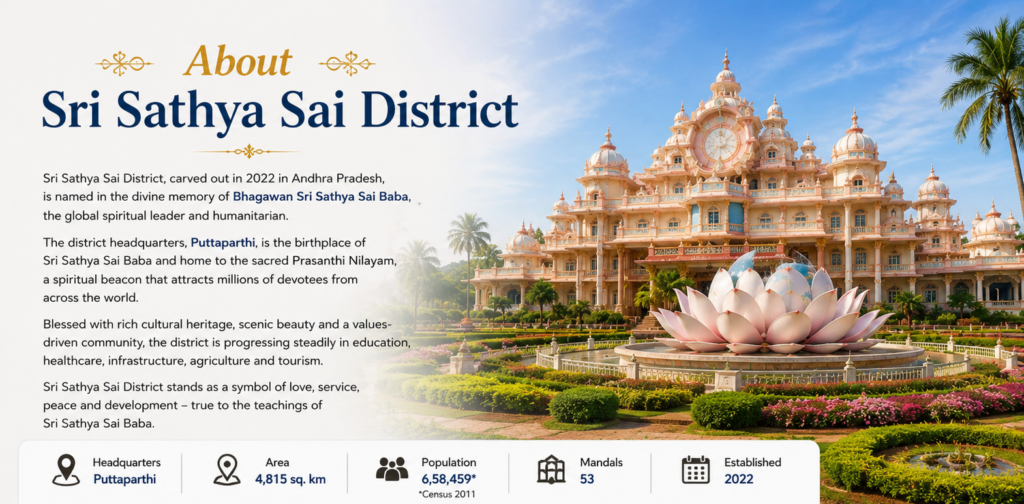
Sri Sathya Sai District is one of the prominent districts of Andhra Pradesh, known for its spiritual significance, cultural heritage, and developmental progress. Established in 2022 during the reorganization of districts in the state, it was named after the revered spiritual leader Sri Sathya Sai Baba, whose birthplace, Puttaparthi, serves as the district headquarters. The district attracts thousands of devotees and tourists from across the world due to the presence of Prasanthi Nilayam, the spiritual abode of Sri Sathya Sai Baba. Blessed with scenic landscapes, agricultural resources, and rich traditions, the district plays an important role in the state’s social and economic development. Along with its spiritual prominence, Sri Sathya Sai District continues to grow in the fields of education, healthcare, infrastructure, and tourism, making it a unique blend of heritage, service, and modern development.
District Overview of Sri satya sai District |
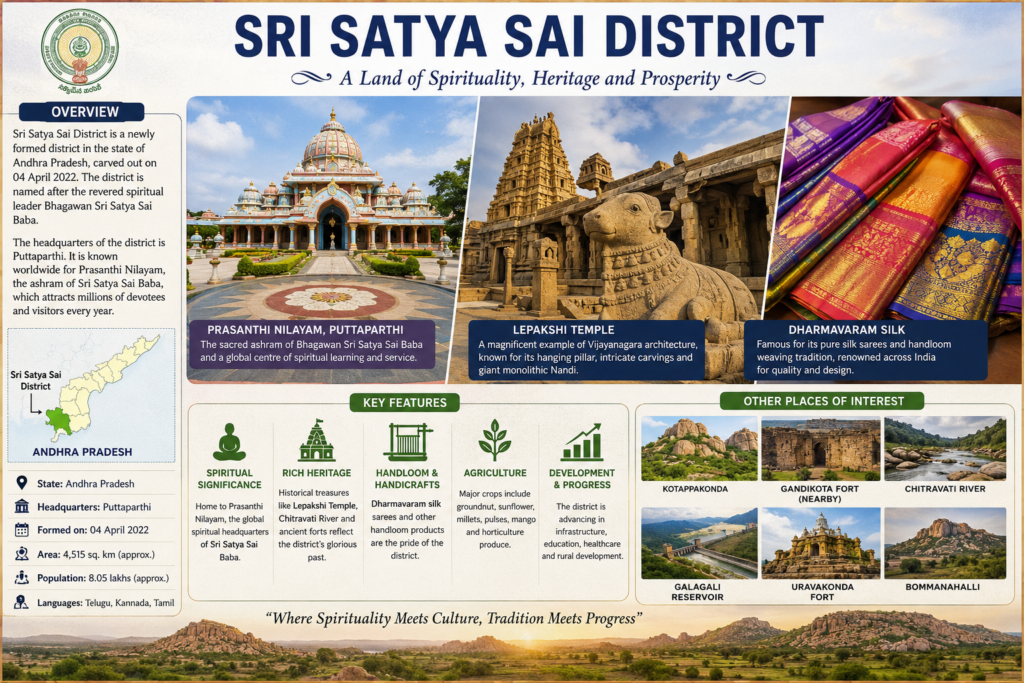
Sri Sathya Sai District is one of the newly formed districts of Andhra Pradesh, established in April 2022 and named in honor of the revered spiritual leader Sri Sathya Sai Baba. With its headquarters located at Puttaparthi, the district is widely known for its spiritual significance, rich cultural heritage, and historical importance. It is home to the world-famous Prasanthi Nilayam, which attracts devotees and visitors from across the globe. The district also boasts remarkable heritage sites such as Lepakshi Temple, celebrated for its stunning Vijayanagara architecture, intricate carvings, and the famous hanging pillar. In addition to its spiritual and historical attractions, Sri Sathya Sai District is renowned for the silk weaving industry of Dharmavaram, whose silk sarees are admired throughout India. Agriculture remains a major source of livelihood, with crops such as groundnut, sunflower, millets, and pulses cultivated extensively across the region. Combining spirituality, tradition, craftsmanship, and agricultural prosperity, Sri Sathya Sai District stands as a vibrant and significant region of Andhra Pradesh.
Formation of Sri Satya Sai district |
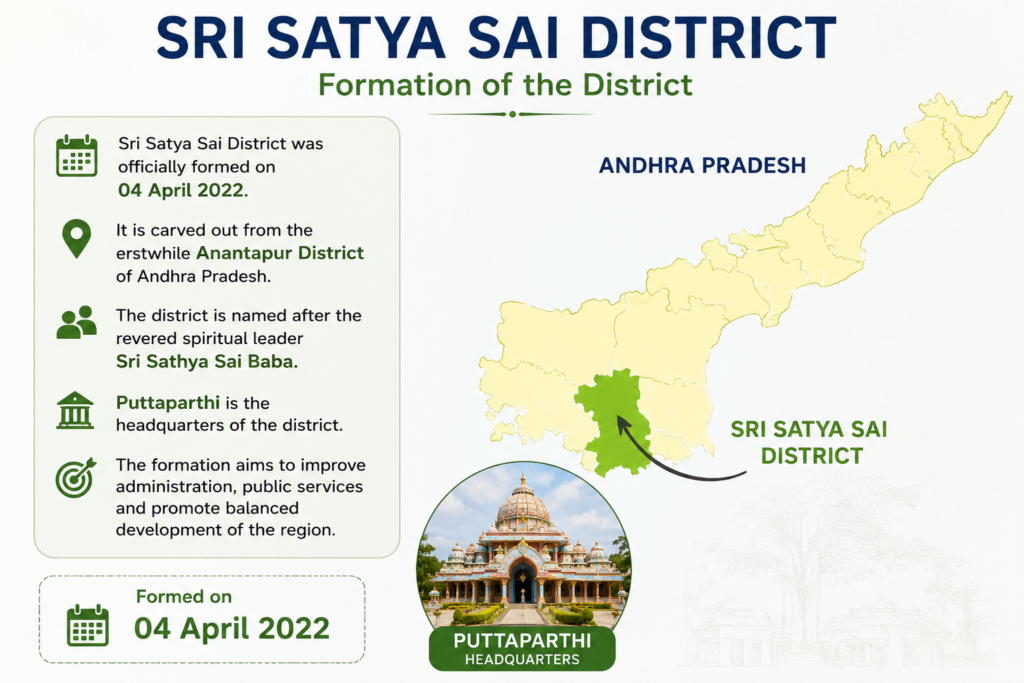
Sri Sathya Sai District was officially established on 4 April 2022 as part of the administrative reorganization undertaken by the Government of Andhra Pradesh. The district was carved out of the erstwhile Anantapur District with the objective of improving governance, decentralizing administration, and ensuring faster delivery of public services to citizens. The newly formed district was named after the revered spiritual leader Sri Sathya Sai Baba, whose teachings of love, service, and humanity have inspired millions across the world.The formation of the district marked a significant step toward regional development by bringing government services closer to the people and enabling better implementation of welfare schemes. Puttaparthi, the birthplace of Sri Sathya Sai Baba and home to the world-famous Prasanthi Nilayam, was chosen as the district headquarters. The district comprises several mandals and towns that contribute to its cultural, agricultural, and economic growth.Since its formation, Sri Sathya Sai District has focused on strengthening infrastructure, improving education and healthcare facilities, promoting agriculture, and preserving its rich cultural and spiritual heritage.
Geographical Location of Sri Satya Sai District |
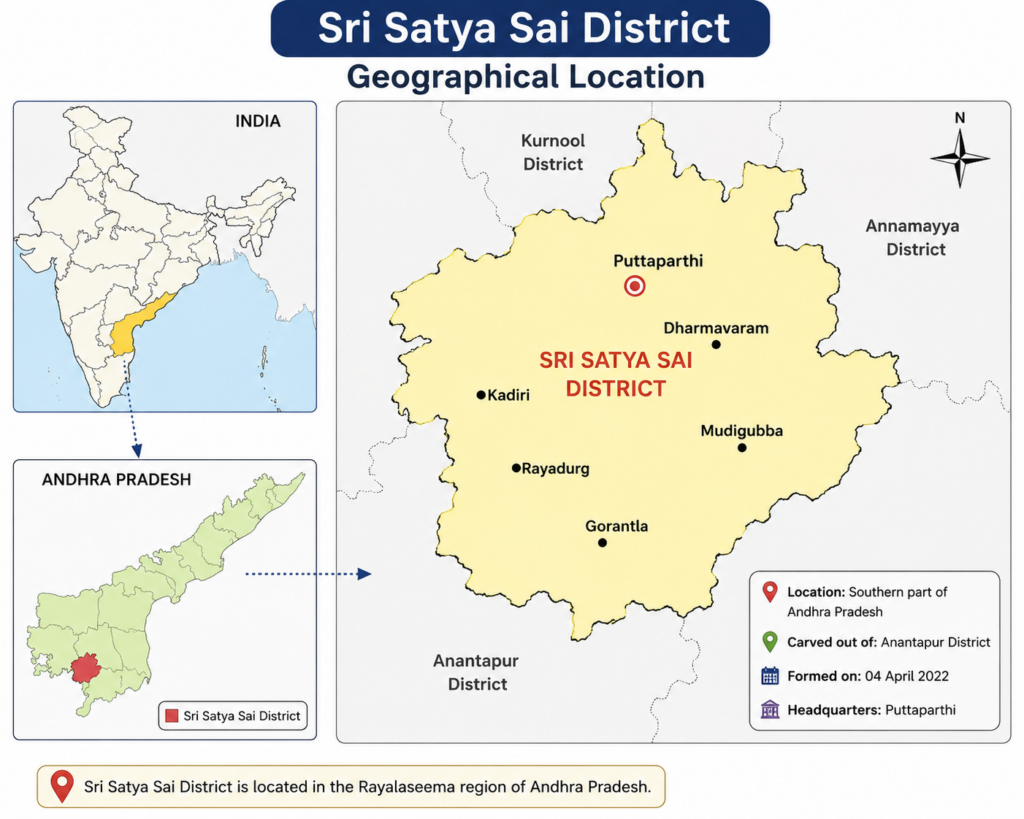
Sri Sathya Sai District is situated in the southwestern part of Andhra Pradesh and forms an important part of the Rayalaseema region. The district was established on 4 April 2022 during the reorganization of districts in the state and has Puttaparthi as its headquarters. Located on the Deccan Plateau, the district is characterized by undulating plains, rocky terrain, low hill ranges, and fertile agricultural lands. Its geographical setting contributes significantly to both agriculture and rural livelihoods.The district is bordered by Anantapur District to the west, Annamayya District to the east, and neighboring regions of Karnataka to the south. Major towns in the district include Dharmavaram, Kadiri, Hindupur, and Puttaparthi. The district enjoys good road connectivity with major cities such as Bengaluru, Anantapur, and Kadapa.Sri Sathya Sai District is also geographically significant because it combines natural beauty, spiritual heritage, and economic activity. The district is home to famous landmarks such as Prasanthi Nilayam in Puttaparthi and Lepakshi Temple, making it a notable destination for pilgrims, tourists, and researchers. Its location in the heart of Rayalaseema contributes to its unique blend of cultural traditions, historical importance, and developmental potential.
Administrative Details of Sri Satya sai District |
The district has a well-structured administrative system consisting of various government departments responsible for education, healthcare, agriculture, rural development, social welfare, and public infrastructure.
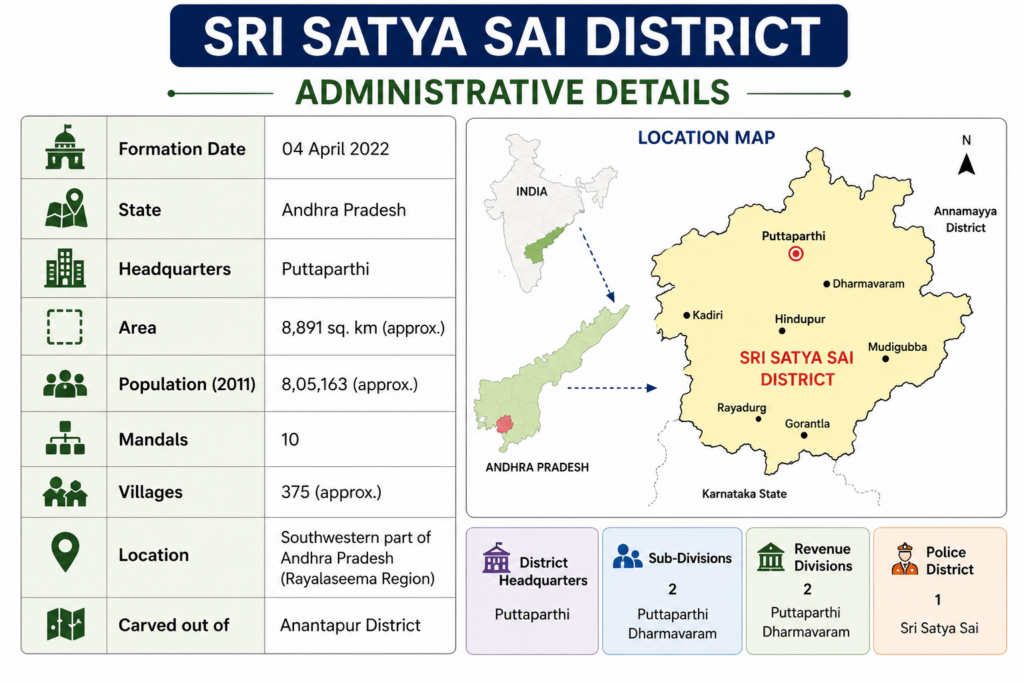
- District Name: Sri Sathya Sai District
- State: Andhra Pradesh
- Region: Rayalaseema
- Headquarters: Puttaparthi
- Formation Date: 4 April 2022
- Carved Out Of: Anantapur District
- Major Towns: Puttaparthi, Dharmavaram, Kadiri, Hindupur
- Administrative Head: District Collector
- Main Languages: Telugu, Kannada, Urdu
- Key Sectors: Agriculture, Handlooms, Tourism, Spiritual Services and Education.
History of Sri Satya Sai District |
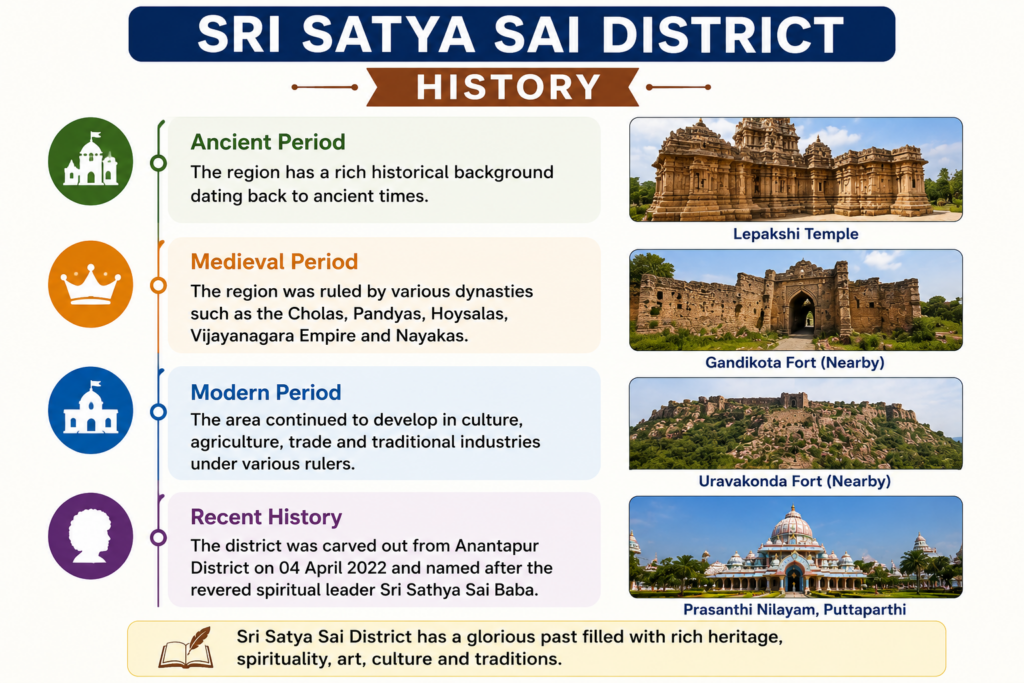
Sri Sathya Sai District has a rich and diverse history that dates back to ancient times. The region was part of several powerful South Indian dynasties, including the Mauryas, Satavahanas, Chalukyas, Hoysalas, and the Vijayanagara Empire. These rulers contributed significantly to the area’s cultural, religious, and architectural development, leaving behind numerous temples, monuments, and historical sites.During the medieval period, the region flourished under the rule of the Vijayanagara Empire. One of the finest examples of this legacy is the Lepakshi Temple, which was built in the 16th century and is renowned for its magnificent architecture, intricate carvings, beautiful murals, and the famous hanging pillar. The temple remains one of the most important historical landmarks in Andhra Pradesh.The region also witnessed the influence of various local kingdoms and administrators who promoted agriculture, trade, and traditional arts. Over the centuries, towns such as Dharmavaram became known for their weaving traditions and cultural heritage, which continue to thrive today.
Cultural Importance of Sri Satya Sai DIstrict |
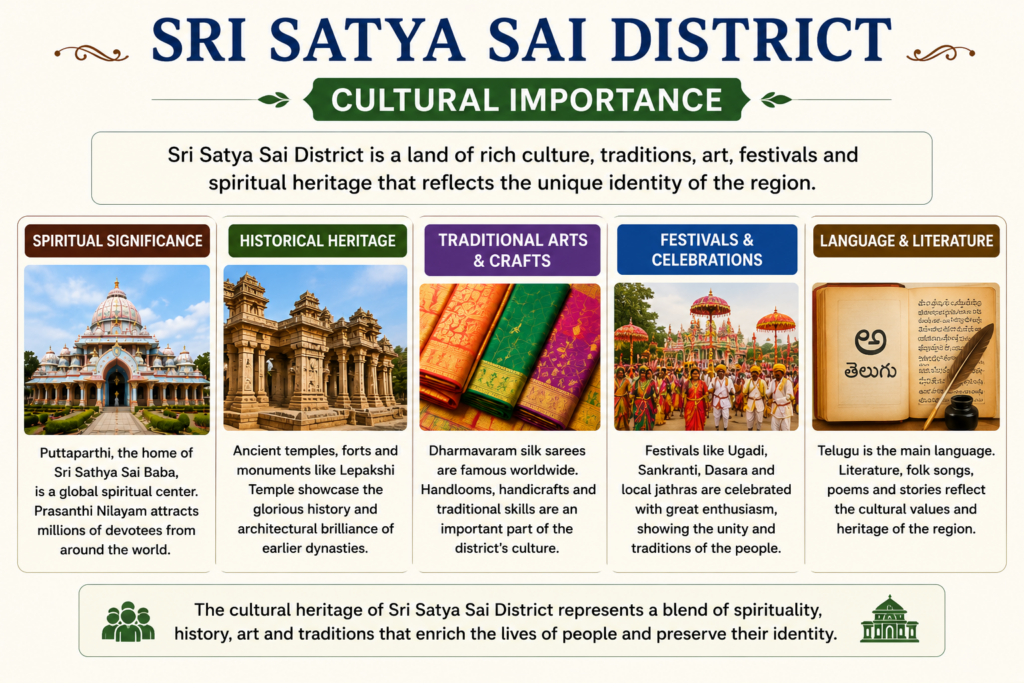
Sri Sathya Sai District is a region rich in cultural traditions, spiritual values, and artistic heritage. The district reflects the vibrant culture of the Rayalaseema region, where customs, festivals, folk arts, and community traditions have been preserved for generations. Its unique blend of spirituality and cultural diversity plays an important role in shaping the identity of the district and its people.The cultural significance of the district is closely linked to Puttaparthi, the birthplace of Sri Sathya Sai Baba. The presence of Prasanthi Nilayam has transformed the district into a global center of spirituality, attracting devotees from different countries and promoting values such as love, peace, service, and universal brotherhood.Traditional arts and crafts form an important part of the district’s cultural heritage. Dharmavaram is world-famous for its exquisite silk sarees, which showcase the skill and creativity of local weavers. Handloom weaving, handicrafts, folk music, and traditional dance forms continue to flourish and contribute to the cultural richness of the region.
Major Towns of Sri Satya Sai District |
| Town | |
| Category | |
| Area | |
| Economy | |
| Major Crops | |
| Revenue | |
| Known For | |
| Tourist Places | |
| Key Feature |
Land Statistics of Sri Satya Sai District |

Area
8,925 sq. km

Elevation
340–900 metres

Forest Area
Around 1,550 sq. km

Land
5,700 sq.km

Region
Rayalaseema
Heritage of Sri Satya Sai District |
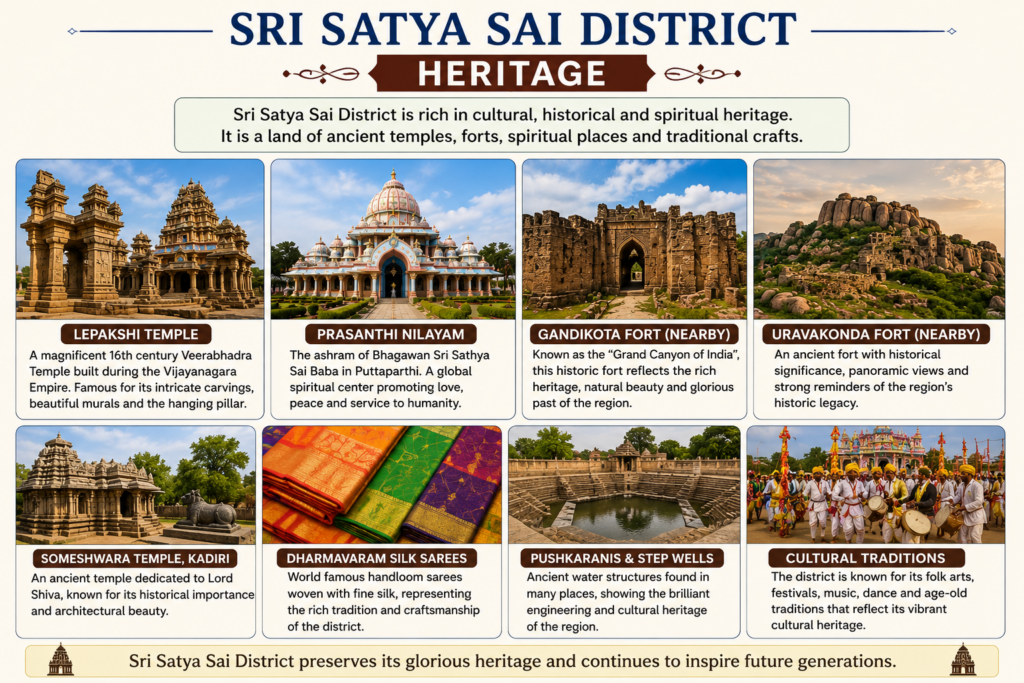
Although the district was officially formed in 2022, its history dates back several centuries and is closely associated with ancient kingdoms, dynasties, and spiritual traditions. Over time, the region came under the influence of various rulers, including the Vijayanagara Empire, whose architectural and cultural contributions continue to be visible in many historical monuments and temples.One of the district’s most celebrated heritage sites is the Lepakshi Temple, a masterpiece of Vijayanagara architecture renowned for its intricate stone carvings, beautiful murals, and the famous hanging pillar. The temple stands as a symbol of the region’s artistic excellence and attracts visitors, historians, and devotees from across the country. The district is also home to several ancient temples, forts, and historical structures that showcase the architectural brilliance and cultural richness of earlier civilizations.The spiritual heritage of the district is equally significant. Puttaparthi, the birthplace of Sri Sathya Sai Baba, has emerged as an internationally recognized spiritual center.
Population of Sri Satya Sai District |
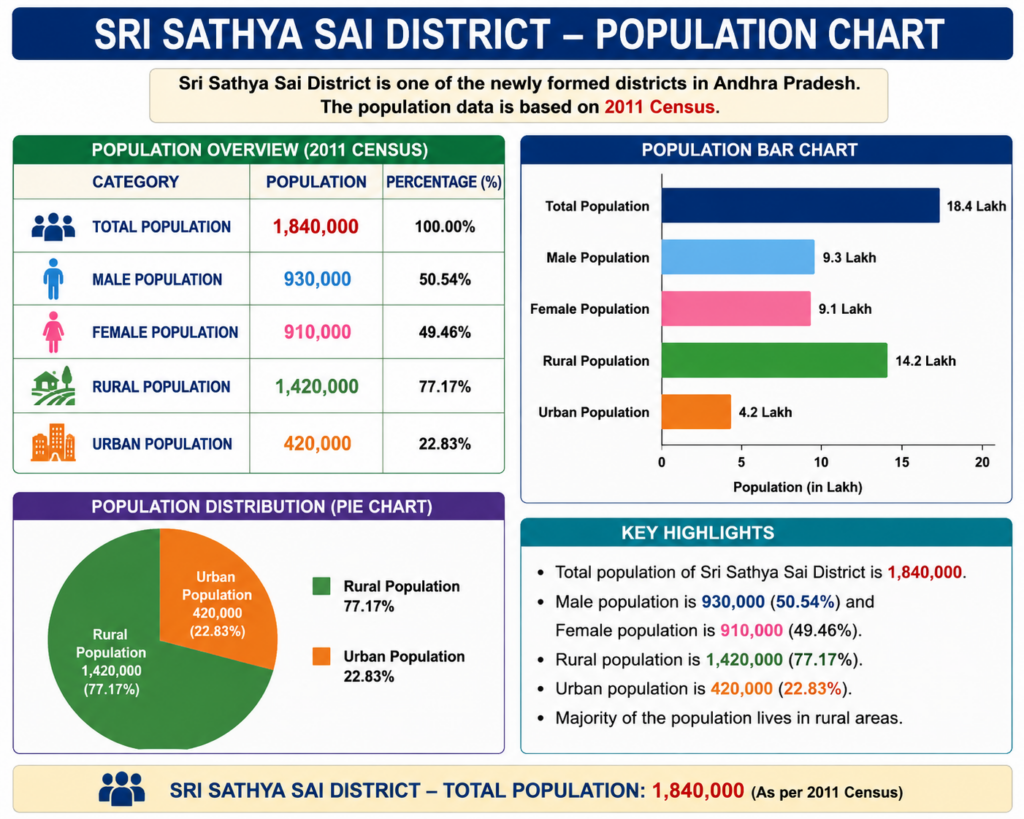
Sri Sathya Sai District, located in the southwestern part of Andhra Pradesh, has a population of approximately 1.84 million according to the 2011 Census. The district has a balanced demographic composition, with around 930,000 males and 910,000 females, reflecting a healthy gender ratio. A significant majority of the population resides in rural areas, accounting for nearly 77% of the total population, while about 23% live in urban centers. Agriculture remains the primary occupation for most residents, and the district is characterized by a network of villages, growing towns, and developing infrastructure. With continuous improvements in education, healthcare, transportation, and public services, Sri Sathya Sai District is steadily progressing toward sustainable social and economic development while preserving its rich cultural and rural heritage.
Demographic Highlights of Sri Satya Sai District |
Total Population
18,40,043
Male Population
9,31,593
Female Population
9,08,540
Literacy Rate
56.10%
Rural Population
14,47,686
Urban Population
3,92,357
Agriculture & Economy of Sri Satya Sai District |
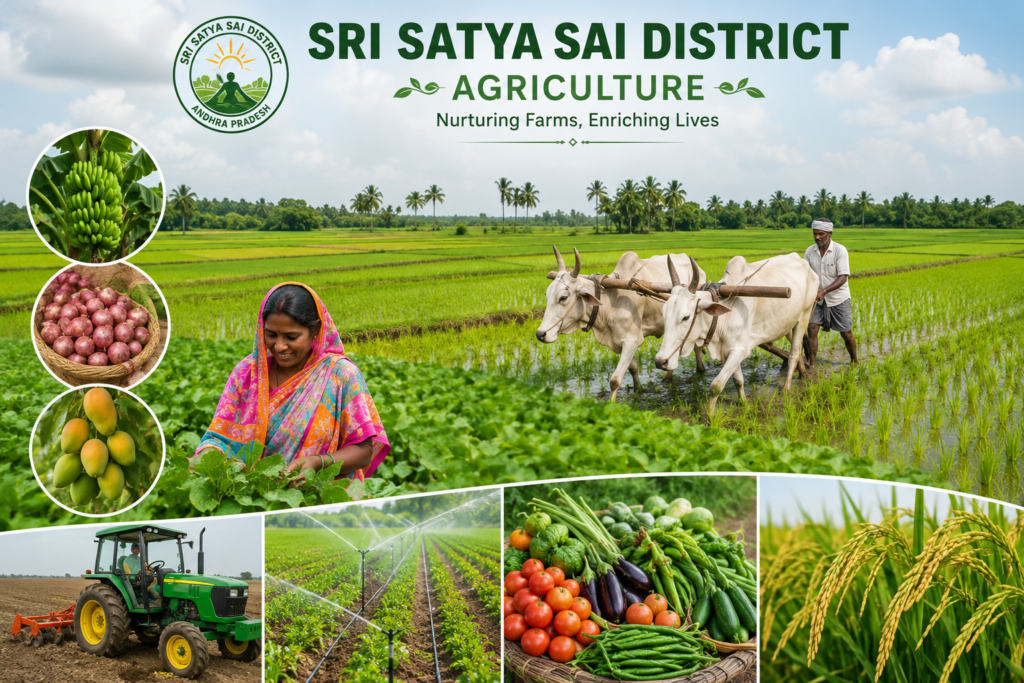
Agriculture is the primary source of livelihood and a major farming plays a vital role in supporting employment and income generation. Major crops cultivated include groundnut, paddy, maize, red gram, bengal gram, sunflower, cotton, millets, and a variety of horticultural crops such as mango, sweet lime, banana, papaya, and vegetables. The economy of Sri Sathya Sai District is driven by a balanced combination of agriculture, horticulture, dairy farming, livestock rearing, small-scale industries, trade, and service sectors. Agro-based industries, food processing units, textile activities, and local markets contribute significantly to economic development and employment. The district also benefits from educational institutions, tourism, and commercial activities that support business growth and generate additional income.Government welfare schemes, rural development programs, and investments in infrastructure continue to strengthen the district’s economic progress, improving the quality of life and promoting sustainable development across both urban and rural areas.
Agriculture
Agriculture
Major crops include groundnut, paddy, maize, red gram, bengal gram, sunflower, cotton, jowar, and ragi. Farmers also cultivate horticultural crops such as mango, sweet lime, banana, papaya, tomato, onion, and chilli.
Dairy Forms
Dairy Forms
Dairy farms, poultry farms, and livestock farming also play an important role in strengthening the agricultural economy and providing employment opportunities in rural areas.

Major Crops
Major Crops
The major crop of the district is groundnut, which is widely grown across the region. Other important crops include paddy (rice), maize, red gram, bengal gram (chickpea), jowar (sorghum), ragi (finger millet), sunflower, and cotton.
Industries
Industries
The district is known for rice mills, groundnut oil mills, cotton ginning units, food processing industries, dairy processing units, textile and garment industries, granite processing units, and engineering workshops.

Statistics Details of Sri Satya Sai District |
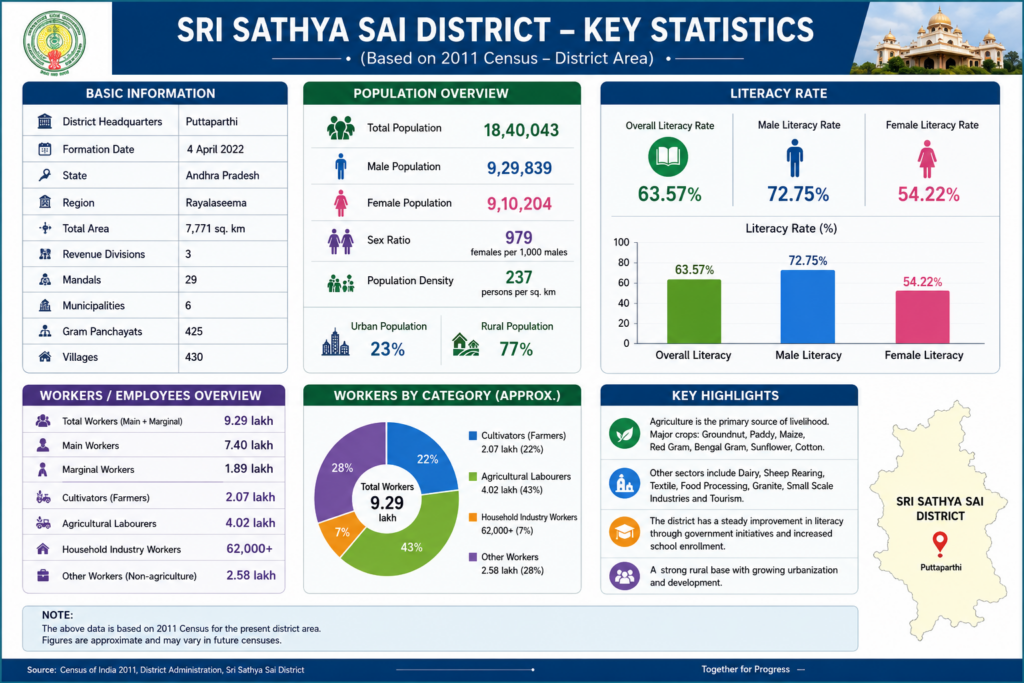
- Total Population: Approximately 18.40 lakh people.
Male Population: Around 9.30 lakh.
Female Population: Around 9.10 lakh.
Sex Ratio: 979 females for every 1,000 males.
Overall Literacy Rate: 63.57%.
Male Literacy Rate: 72.75%.
Female Literacy Rate: 54.22%.
Total Workers: Around 9.29 lakh people are engaged in various occupations.
Major Occupations: Farming, agricultural labour, government jobs, private employment, trade, transport, education, healthcare, and other services.
Cultivators (Farmers): Nearly 2.07 lakh.
Agricultural Labourers: About 4.02 lakh.
Population Density: Approximately 237 persons per square kilometre.
Rural Population: Around 77% of the district’s population.
Urban Population: Around 23% of the district’s population.